This MSME Day (June 27), here’s a truth most founders learn the expensive way: products don’t fail. Great products with poor Go-to-Market (GTM) strategies do.
As founders, we obsess over building the product. We refine every feature, solve technical challenges, navigate compliance, hire the right people, and stretch every rupee to make the business work.
Then comes the question:
“Now, how do we sell it?”
That’s where many scaling journeys begin to crack.
Every year on June 27, the world pauses to recognise something it usually takes for granted: that Micro, Small, and Medium Enterprises aren’t the “small” players in the economy, they are the economy. MSMEs make up roughly 90% of all businesses globally, generate 60-70% of jobs, and contribute close to half the world’s GDP (Source: https://www.un.org/en/observances/micro-small-medium-businesses-day). In India alone, MSMEs touch nearly every sector, from a kefir startup in a Chennai kitchen to an aerospace engineering firm building for the skies.
And yet, here’s the paradox we see in our work every single day: the same founders who can build a flawless product, navigate compliance, manage cash flow on a knife’s edge, and wear eleven hats before lunch often have no real go-to-market (GTM) strategy.
But ask them:
- Who is your Ideal Customer Profile?
- Why should they buy from you instead of the alternatives?
- Which acquisition channel consistently works?
- What does it cost you to acquire one customer?
- Is your sales process repeatable?
The room often goes silent.
Because innovation creates products. GTM creates businesses.
Go-to-Market (GTM) isn’t a marketing campaign you launch after the product is ready. It’s the business strategy that should shape everything from who you’re building for, to why they’ll choose you, how you’ll reach them, and how you’ll grow profitably
Related Topics:
How To Promote Events on Facebook
Top 5 Books on Design Thinking
Digital Marketing Strategy for Higher Education Institutions in India
Pipeline acceleration: strategies that show up on dashboards
We’ve sat across the table from enough founders through our Launchpad program and beyond to know exactly where this goes wrong. So instead this MSME day, instead of another generic “10 marketing tips” checklist, I want to leave every founder with something more useful: a diagnostic. Ten questions.
If you can answer all ten with conviction, you’re ready to scale. If you stumble on even three or four, you’ve likely discovered the real reason your growth has plateaued before your next marketing budget teaches you the same lesson.
The Questions you need to ask:
- 1. Who exactly is your customer and what are they doing instead of buying from you?
- 2. What problem do you solve that's painful enough for someone to actually switch?
- 3. Is your brand identity built for where you're going or just where you started?
- 4. Can a complete stranger understand what you do in five seconds?
- 5. What's your single most efficient channel right now and what happens if it disappears tomorrow?
- 6. Do you have a repeatable sales motion or is every deal a one-off improvisation?
- 7. What does your pricing actually say about your positioning?
- 8. Are your GTM assets built for where you're launching from or where you're trying to land?
- 9. What's your proof and can you show it before you're asked for it?
- 10. What will break first when you 10x your team, your ops, your brand, or your cash?
1. Who exactly is your customer and what are they doing instead of buying from you?
Most MSMEs describe their customer in terms too wide to be useful: “working professionals,” “small businesses,” “health-conscious people.” That’s not a customer. That’s a census category.
The real question isn’t just who buys from you. It’s: what are they currently doing to solve this problem without you? Because you’re not just competing with direct competitors — you’re competing with inertia, with substitutes, and with “doing nothing.”
A real-world example: When HappieGut, India’s first ready-to-drink kefir brand, came to Launchpad by Bunjy, the founder wasn’t just launching a probiotic drink, she was asking Indian households to replace a centuries-old habit (curd, buttermilk, lassi) with an unfamiliar fermented milk product most people couldn’t pronounce. The competitor wasn’t another kefir brand. It was a steel tumbler of homemade buttermilk on every Indian dining table. Until that was named clearly, no amount of “probiotic benefits” messaging was going to move anyone.
Ask yourself:
- Can you describe your customer specifically enough that you could picture them walking into a room?
- What’s their current alternative: a competitor, a substitute, or simply not solving the problem at all?
- Have you actually talked to 10+ of them recently, or are you working off assumptions from your launch year?
Red flag: Your customer profile hasn’t changed since day one, even though your product, pricing, or market has.
2. What problem do you solve that’s painful enough for someone to actually switch?
There’s a difference between a feature people like and a problem painful enough that people will change their behaviour, their budget, or their supplier to fix it. MSMEs scaling on the first kind plateau fast. MSMEs scaling on the second kind compound.
This is where most founders confuse “nice to have” with “needed.” If your pitch is a list of features, you haven’t found the pain yet, you’ve found the product.
Ask yourself:
- If your product disappeared tomorrow, what would your customer actually lose: money, time, risk, status, peace of mind?
- Can you say the problem in one sentence without using your own product’s name?
- Would a customer pay more to solve this problem faster, or are they only buying because you’re the cheapest option in the category?
Red flag: Your sales conversations spend more time explaining the product than discussing the customer’s problem.
3. Is your brand identity built for where you’re going or just where you started?
Here’s something MSMEs underestimate constantly: a brand identity built for “getting started” often becomes the exact thing holding the business back from “getting serious.”
This isn’t about logos for vanity’s sake. In B2B, deep-tech, and specialised categories especially, your visual identity is doing real commercial work, it’s a credibility signal before a single conversation happens.
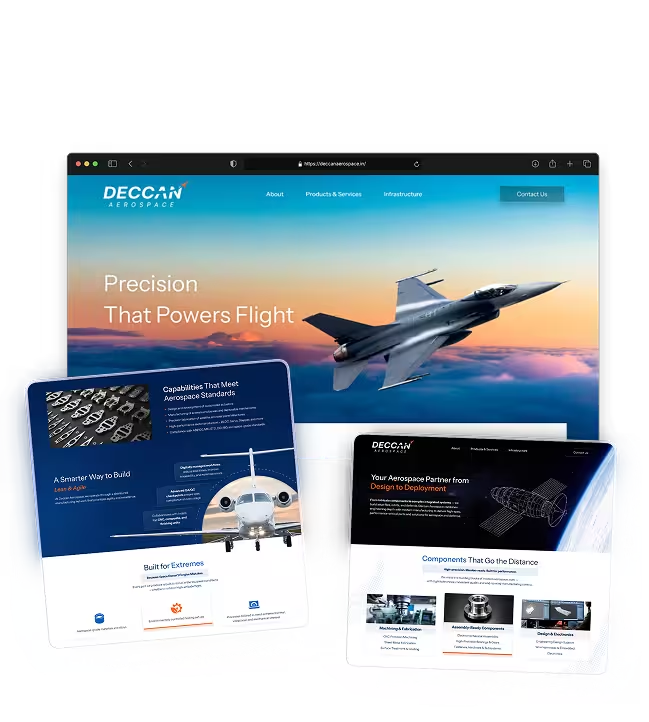
A real-world example: Deccan Aerospace, a forward-looking aerospace engineering company, came to us needing exactly this kind of shift. As a specialised player trying to win trust with industry stakeholders, defence-adjacent partners, and engineering-grade clients, an identity that looked like “any other startup” simply wasn’t going to cut it. We designed a mark built around a space jet in ascent, leaving a dynamic trail through the clouds, to visually communicate ambition, speed, and engineering precision before a single sales deck was opened. That’s not decoration. In a sector where credibility is the entry ticket, the logo is part of the pitch.
Ask yourself:
- If a prospect saw only your logo, website, and one-pager with no human conversation, would they believe you belong in the league you’re trying to play in?
- Has your identity evolved since your first year, or are you scaling with a “scrappy startup” look in a market that now expects “serious operator”?
- Does your visual identity match the price point and seriousness of the deals you’re now trying to close?
Red flag: You’re closing bigger, more sophisticated clients, but your brand still looks like it’s introducing itself for the first time.
4. Can a complete stranger understand what you do in five seconds?
Founders live inside their own business 16 hours a day. That makes it almost impossible to see how confusing the outside view actually is. If your website, your pitch deck, or your storefront needs a verbal explanation to make sense, you don’t have a messaging problem, you have a growth ceiling.
This matters double for MSMEs entering a new or unfamiliar category, where the audience has zero existing mental model to slot you into.
A real-world example: When Unnati, the vocational training and employability initiative under AMJ College, needed to go to market, the core challenge wasn’t lack of value. It was lack of clarity. A brand-new skilling program, with no defined identity or positioning, was being asked to simultaneously convince students it was worth their time, convince industry partners it was worth a placement relationship, and convince the institution it deserved investment without a name, logo, or website to anchor any of that trust. We ran positioning workshops first, before a single design decision, because clarity has to come before assets, not the other way around.
Ask yourself:
- Hand your homepage to someone outside your industry. Can they tell you, unprompted, what you do and who it’s for?
- Does your pitch lead with what you are, or with what changes for the customer because you exist?
- Is your message the same across your website, your sales deck, and what your team says on calls or does each one tell a slightly different story?
Red flag: New customers regularly ask “wait, so what exactly do you guys do?” after looking at your website.
5. What’s your single most efficient channel right now and what happens if it disappears tomorrow?
Most MSMEs grow through one disproportionately effective channel: a referral network, one marketplace, one salesperson’s relationships, one ad platform that happened to work. That’s normal in the early stage. What’s dangerous is scaling on top of that single channel without ever diversifying it.
This is the quiet killer of “successful” MSMEs: revenue looks healthy right up until the one channel it depended on changes its algorithm, raises its prices, or the one relationship manager leaves.
Ask yourself:
- What percentage of your current revenue comes from your single best-performing channel?
- If that channel’s cost doubled overnight, would your unit economics survive?
- Have you actually tested a second channel with real budget or just talked about it?
Red flag: You can’t answer “what % of revenue comes from our top channel” within ten seconds.
6. Do you have a repeatable sales motion or is every deal a one-off improvisation?
In the early days, every founder is the best salesperson in the company because they are the company. The problem is when that stays true at scale. If every successful deal closed because of who pitched it, rather than what was pitched and how, you don’t have a sales process, you have a personality-dependent miracle that doesn’t survive your first hire.
Ask yourself:
- Could a new salesperson, with no relationship history, close a similar deal using only what’s documented?
- Do you know your average sales cycle length, or does “it depends” answer every question about your pipeline?
- Is there a defined sequence of steps from first contact to signed deal or does every deal find its own path?
Red flag: Your best month and your worst month can’t be explained by anything except “who happened to be selling.”
7. What does your pricing actually say about your positioning?
Pricing isn’t just a finance decision, it’s a marketing signal. MSMEs frequently underprice out of fear of losing the deal, without realising that pricing is one of the loudest messages you send about quality, seriousness, and category.
If you’re the cheapest option in the room, you’ve effectively told the market what you think you’re worth and competing on price is a race that ends with someone who has lower costs than you.
Ask yourself:
- Are you pricing based on the value you create, or on what feels “safe” not to lose the sale?
- If a competitor matched your price exactly tomorrow, what’s left to differentiate you?
- Have you actually tested a price increase with new customers, or are you assuming the market won’t bear it?
Red flag: Your pricing strategy is “whatever the last customer agreed to pay.”
8. Are your GTM assets built for where you’re launching from or where you’re trying to land?
This is one founders consistently get backwards. They build a pitch deck, a website, and collateral to launch the business and then keep using those same assets two funding rounds, three new markets, and ten enterprise clients later. Your GTM assets need to be built for the next stage of credibility, not just the current one.
A real-world example: HappieGut’s GTM work through Launchpad by Bunjy didn’t stop at brand identity. Because the founder was also looking toward funding conversations, we built a dedicated investor pitch deck alongside the brand assets, strategically positioning the business for capital and market growth, not just for its first hundred customers. That distinction matters: a deck built to win customers and a deck built to win investors are not the same document, even if they share a brand.
Ask yourself:
- Is your pitch deck still the one you used to raise your first round or has it evolved with your traction?
- Do your sales materials reflect the size of client you’re now trying to close, or the size you used to close?
- If an investor or a Tier-1 client asked for your materials tomorrow, would you be proud to send what currently exists?
Red flag: You find yourself saying “let me update the deck” before every important meeting because it’s chronically out of date.
9. What’s your proof and can you show it before you’re asked for it?
Trust is the actual currency in any sale, and MSMEs, lacking the brand recognition of larger players, have to earn trust faster and more visibly than incumbents do. That means your proof points (certifications, results, credible founders, case studies, even something as simple as a professional, fast-loading website) need to do work before a prospect asks “can you prove that?”
A real-world example: ClothMeds, a bio-based antimicrobial scrubs manufacturer, needed exactly this kind of proof-forward presence to support a direct-to-consumer e-commerce launch. Rather than relying on offline trust-building alone, we built a cost-effective e-commerce platform that let the brand demonstrate credibility, sustainability claims, and product quality directly driving organic visibility and a meaningfully more cost-effective growth motion, with the brand reporting 60% cost savings versus its prior approach.
Ask yourself:
- If a skeptical prospect Googled you right now, what would they find in the first 30 seconds?
- Do you have at least one quantified result you can point to (cost saved, time saved, growth driven) or only qualitative claims?
- Are you making your proof easy to find, or does someone have to ask for it directly?
Red flag: Your strongest proof points live in a WhatsApp testimonial screenshot instead of somewhere a prospect can find on their own.
10. What will break first when you 10x your team, your ops, your brand, or your cash?
This is the question founders avoid because answering it honestly is uncomfortable. But scaling without knowing your own breaking point is how MSMEs go from “growing” to “drowning” within two quarters.
Every business has a bottleneck that doesn’t show up at current volume but becomes catastrophic at 5-10x volume. It might be a founder who’s still the only person who can close deals. It might be a fulfilment process that works for 50 orders a day but collapses at 500. It might be a brand that hasn’t earned the right to charge enterprise prices yet. Knowing which one it is, before you scale, is the difference between a growth plan and a crisis waiting to happen.
Ask yourself:
- If demand tripled next quarter, which part of the business would visibly struggle first?
- Have you actually stress-tested this assumption, or is it a guess?
- Does your GTM plan account for this bottleneck, or does it only plan for the upside?
Red flag: Your growth plan has a revenue target but no answer to “and what breaks if we hit it?”
Quick-Reference: The MSME GTM Health Check
# | Question | Risk |
|---|---|---|
1 | Who exactly is your customer and what are they doing instead of buying from you? | Wasted spend chasing the wrong audience |
2 | What problem do you solve that’s painful enough for someone to actually switch? | Plateauing on “nice to have” demand |
3 | Is your brand identity built for where you’re going or just where you started? | Losing serious deals on first impression |
4 | Can a complete stranger understand what you do in five seconds? | A growth ceiling you can’t see from inside |
5 | What’s your single most efficient channel right now and what happens if it disappears tomorrow? | Revenue collapse from a single point of failure |
6 | Do you have a repeatable sales motion or is every deal a one-off improvisation? | A business that can’t survive its own scaling |
7 | What does your pricing actually say about your positioning? | A race to the bottom you can’t win |
8 | Are your GTM assets built for where you’re launching from or where you’re trying to land? | Losing credibility with investors or big clients |
9 | What’s your proof and can you show it before you’re asked for it? | Trust gaps that slow every single sale |
10 | What will break first when you 10x your team, your ops, your brand, or your cash? | A growth spurt that turns into a crisis |
The Common Thread
Look back at HappieGut, Deccan Aerospace, Unnati, and ClothMeds, and you’ll notice none of these were “marketing projects” in the traditional sense. They were clarity projects. Each founder had real value to offer, a genuinely novel product, real engineering capability, a real training program, a real sustainability story but needed the go-to-market layer built deliberately instead of accidentally.
That’s the cheat code, if there is one: GTM isn’t something you bolt onto a good product. It’s the translation layer between what you’ve built and what the market is willing to pay for. MSMEs that treat it as a one-time launch task hit a ceiling. MSMEs that treat it as a living strategy, revisited every time they’re about to scale, keep compounding.
This MSME Day, the most useful thing you can do for your business isn’t a discount code or a LinkedIn post about your journey (though, by all means, do that too). It’s sitting down with these ten questions, answering them honestly, and being willing to admit where the answer is “I don’t actually know.”
Because the founders who scale well aren’t the ones with the fewest gaps. They’re the ones who found their gaps before the market did.
Thinking about your own GTM gaps?
This is exactly the work we do inside Launchpad by Bunjy, our GTM accelerator built for startups and MSMEs that need branding, positioning, and go-to-market strategy bundled into one focused sprint, instead of figured out the hard way.
From HappieGut’s brand and investor story to Deccan Aerospace’s identity to Unnati’s market-facing launch, the pattern is always the same: answer the hard questions early, and scaling stops being a gamble.
want to know more visit: B2B Marketing Agency