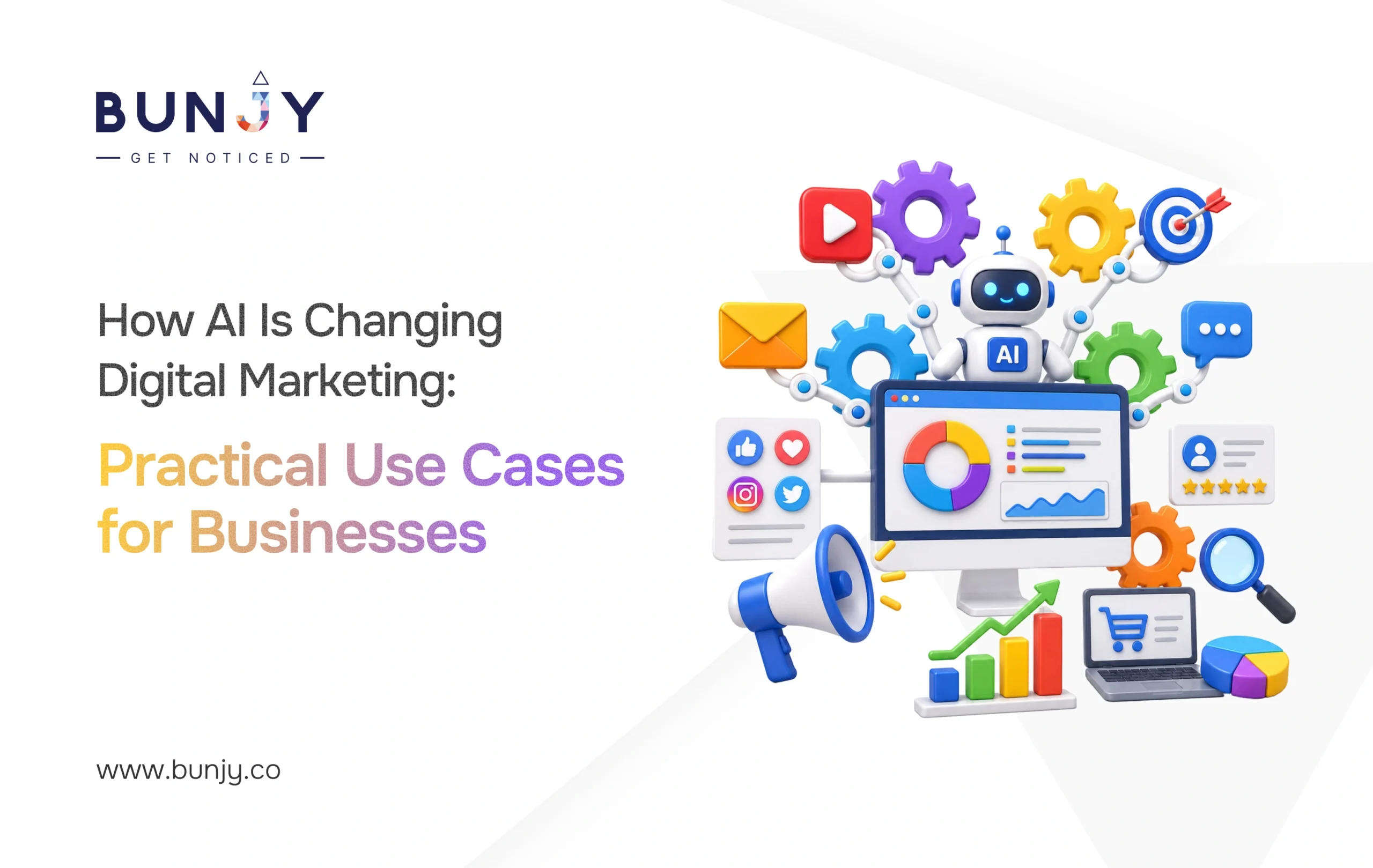
Artificial intelligence is no longer a future technology, it’s reshaping digital marketing right now. From content creation to customer personalization to campaign optimization, AI is fundamentally changing how businesses reach, engage and convert customers.
Yet many organisations view AI as either a threat to their teams or an expensive experimental investment. The reality is more nuanced. AI is a powerful tool that amplifies human expertise, automates repetitive work and enables marketers to operate at scale they couldn’t achieve before.
In 2026, businesses that strategically implement AI marketing tools are experiencing faster campaign execution, better targeting precision, improved conversion rates and measurable ROI improvements. But understanding which use cases actually deliver business value is critical, not all AI applications in marketing are equally effective.
Here’s how AI is changing digital marketing and which use cases deliver the strongest practical benefits.
AI-Powered Content Creation at Scale
One of the most visible applications of AI in marketing is content generation. Tools like ChatGPT, Claude and specialised marketing platforms can now generate blog posts, email copy, social media content and ad creative in minutes rather than hours.
The challenge isn’t whether AI can create content, it clearly can. The challenge is ensuring the content maintains quality, brand consistency and effectiveness.
AI excels at generating initial content frameworks, outlines and rough drafts that human writers can refine to accelerate the creative process. It’s valuable for testing multiple message variations through generating dozens of subject line options, email variations or social copy angles in minutes for testing and optimization.
AI can analyse top-performing pages and generate SEO-optimised landing page copy that incorporates relevant keywords and proven patterns. It efficiently repurposes single pieces of content for different formats while maintaining message consistency. For e-commerce and SaaS companies, AI generates product descriptions and technical documentation much faster than manual creation.
Related Topics:
10 Strategies To Boost Organic Traffic
10 Instagram Trending Formats You Should Try out!
Pipeline acceleration: strategies that show up on dashboards
However, the most successful implementations combine AI content generation with human review and optimisation. AI-generated content should be treated as a starting point, not the final output. The highest-performing campaigns use AI to accelerate production while maintaining human judgment around tone, accuracy and strategic alignment.
Predictive Analytics and Customer Insights
Beyond content creation, AI’s most powerful application in marketing is pattern recognition: analysing vast amounts of customer data to predict behavior and identify opportunities humans would miss.
AI models can analyse which leads are most likely to convert based on their behavior, engagement patterns and firmographic data, enabling sales teams to prioritize high-probability prospects and improve efficiency. It identifies which existing customers are at risk of leaving based on engagement patterns and usage data, enabling proactive retention campaigns before customers actually churn.
AI creates lookalike audience models by analysing your best customers and identifying similar prospects across databases or advertising platforms, improving targeting precision significantly. It determines optimal timing and channels for reaching individual customers, improving response rates through intelligent personalization. AI recommendation engines analyze customer behavior to suggest products or features, increasing average order value and feature adoption.
These use cases share a common theme: they transform raw data into actionable customer insights that drive measurable performance improvements.
Marketing Automation and Personalisation
AI enables personalization at scale, something that was theoretically possible but practically difficult before. Today’s AI-powered marketing automation platforms can deliver unique experiences to thousands of customers simultaneously.
Website content, email copy and landing pages automatically adjust based on visitor attributes like location, industry and previous interactions, ensuring each visitor sees the most relevant message. Customers automatically receive specific emails or messages based on their actions like abandoned carts or reaching usage milestones, with these triggered campaigns often showing 2-3x higher engagement. Rather than static email sequences everyone receives identically, AI-powered sequences adapt based on customer engagement, delivering different follow-up content to engaged versus disengaged customers. AI determines the optimal send time for each individual customer based on their historical patterns, increasing open rates without manual scheduling.
The business impact is significant, with personalised campaigns typically showing 20-40% higher conversion rates than generic broadcasts.
AI-Enhanced Paid Advertising
Digital advertising has become increasingly competitive, and AI is changing how campaigns are managed and optimised.
AI algorithms adjust bids in real-time based on likelihood of conversion, ensuring marketing budgets are allocated efficiently across keywords, audiences and channels. AI automatically tests multiple ad variations, identifies top performers and allocates budget toward winning creative combinations, removing guesswork from creative testing.
Platforms use AI to expand campaigns to similar audiences beyond initial targets, discovering new customer segments with high conversion probability. AI models how different touchpoints across a customer’s journey contribute to conversions, not just crediting the final click, revealing which channels truly drive business results. Before investing in campaigns, AI can predict likely ROI based on historical data, helping allocate budgets more strategically.
These AI features have made digital advertising more efficient and less dependent on manual optimization. Teams can focus on strategy while algorithms handle real-time tactical adjustments.
AI for Customer Service and Engagement
Beyond customer acquisition, AI is transforming how businesses engage existing customers through service and support interactions.
AI-powered chatbots handle common customer questions, provide product recommendations and route complex issues to human agents, reducing support costs while improving customer accessibility. AI analyzes customer messages, reviews and social media mentions to understand sentiment and enable proactive reputation management.
Conversational marketing systems engage website visitors in natural conversations, answer questions and qualify leads automatically, improving conversion rates and reducing response time. AI analyzes customer feedback and support tickets to identify common themes, pain points and feature requests that guide product development and marketing messaging.
These applications improve customer satisfaction while reducing operational costs, creating a win-win scenario.
Key Considerations for AI Implementation
For businesses considering AI marketing tools, several factors determine success.
- Data quality matters significantly: AI models are only as good as the data they’re trained on, with organisations having clean, organized customer data seeing better results.
- Human oversight is essential since AI should augment human judgment rather than replace it, with the most successful implementations combining AI insights with human strategic thinking.
Start with high-impact use cases like lead scoring or email personalisation rather than trying to implement AI across all marketing functions at once. Integration with existing tools is important since AI works best when integrated into your existing marketing stack rather than as isolated tools. Team training is critical as your marketing team needs to understand AI capabilities and limitations to work effectively with these systems.
Final Thoughts
AI is not disrupting digital marketing in 2026, it’s enhancing it. Organisations that strategically implement AI marketing tools are gaining competitive advantages through better targeting, faster execution, improved personalization and more efficient budget allocation.
However, AI success requires more than tool adoption. It requires strategic thinking about which use cases deliver real business value, commitment to data quality and governance, and investment in team capabilities to work effectively with AI systems.
For businesses serious about scaling marketing effectiveness in 2026, AI is no longer optional. The question isn’t whether to use AI in marketing, it’s how to implement it strategically to deliver measurable business results.
For more information, explore our digital marketing services in Chennai.
FAQ
How is AI being used in digital marketing today?
AI is used for content creation, customer support, ad targeting, predictive analytics, personalisation, and marketing automation.
Can AI improve customer targeting in advertising?
Yes. AI analyses user behavior and data patterns to help businesses deliver more relevant ads to the right audience.
How does AI help with content marketing?
AI tools can assist with generating content ideas, optimising SEO, analyzing performance, and improving content personalisation.
Is AI useful for small businesses in marketing?
Absolutely. Many affordable AI tools help small businesses automate tasks, improve efficiency, and compete more effectively online.
What are the benefits of AI-powered chatbots?
AI chatbots provide instant customer support, answer common questions, improve response times, and enhance user experience.
Does AI replace human marketers?
No. AI supports marketers by automating repetitive tasks and providing insights, while human creativity and strategy remain essential.
Related Case Studies

Categories: Blog