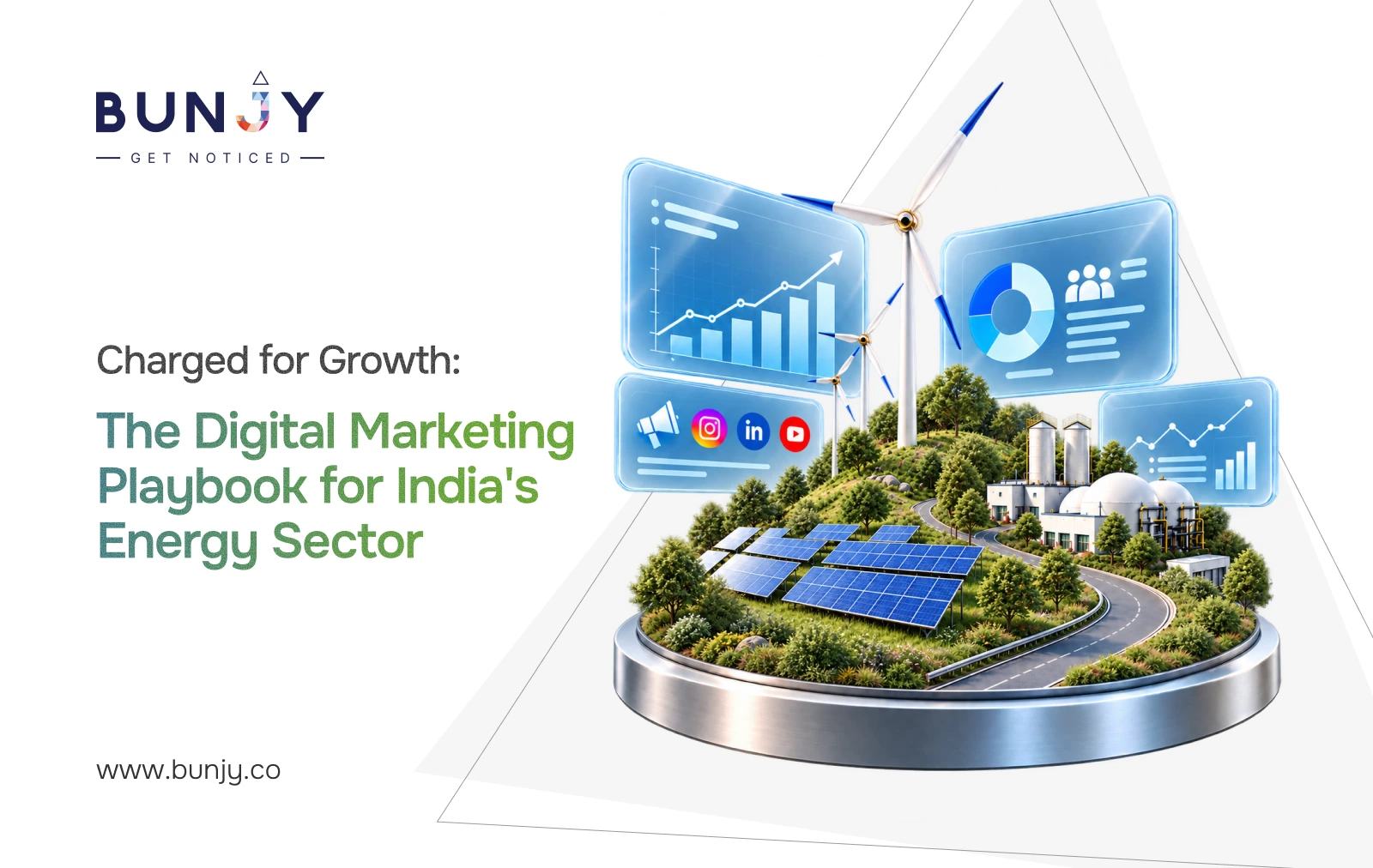
India’s solar capacity grew from 3 GW in 2014 to 140 GW as of January 2026 (Source:
→ SolarQuarter / Press Information Bureau). The Union Budget 2026–27 allocated ₹44,614 crore to renewable energy: a 40% jump over the previous year. Indian conglomerates have committed ₹800 billion to green hydrogen, clean energy, semiconductors, and EVs by 2034 (Source: IBEF Renewable Energy Industry Analysis). By every measure, India’s energy sector is in the middle of one of the most significant industrial transformations in its history*.
And yet, ask most energy companies how their digital presence reflects that transformation, and the honest answer is: it doesn’t. Not even close.
Energy companies, particularly in the mid-market and emerging clean energy space, still largely operate with digital presences built for a different era of the industry: websites that explain services in technical jargon written for procurement teams, LinkedIn pages that post tender wins and CSR photos once a month, and no coherent content strategy connecting what they do to why the market should care about them specifically when there are 200 other companies doing something adjacent. As the sector accelerates, the gap between what these companies are actually doing and what their digital presence communicates is growing, not shrinking.
This isn’t a cosmetic problem. In a sector where sales cycles are long, credibility is the entry ticket, and the buyer, whether a corporate PPA offtaker, a DFI, a government tender committee, or a C&I client evaluating a solar rooftop partner, almost always does significant independent research before initiating contact, a weak or incoherent digital presence isn’t just a missed opportunity. It’s an active commercial disadvantage.
Here’s an honest look at where the energy sector’s digital challenge actually sits and what the companies getting it right are doing differently.
Why Energy Companies are Structurally Behind on Digital
The energy sector has traditionally sold through relationships, not digital channels. A business development director who spent twenty years building connections at MNRE, DISCOMs, and major PSUs didn’t need a website to win work. A mid-sized EPC firm with a strong project track record and the right regulatory relationships could grow steadily without ever publishing a LinkedIn post.
Related Topics:
7 Common SEO mistakes you should avoid
How IT Companies Worldwide Can Generate More B2B Leads Through Digital Marketing in 2026
How to choose a branding agency in 2026
7 Website Mistakes That Are Costing Your Business Leads
The Thin Line in Marketing: Understanding Ethics in the Art of Persuasion
That model worked. Past tense.
Three structural shifts have changed what’s required:
The buyer has changed. The C&I segment: manufacturing firms, commercial real estate developers, campuses, and data centres buying renewable energy directly through PPAs, open access, or rooftop now represents a massive and fast-growing share of clean energy demand in India. These buyers don’t move through the same procurement channels as PSUs. Their decision-makers are CFOs, sustainability heads, and operations directors who research vendors online, read sector commentary, look up LinkedIn profiles, and form an opinion about whether a company is credible before they ever agree to a meeting.
The competitive field has exploded. India’s energy transition has attracted capital, conglomerates, and startups at scale. A C&I client evaluating green energy procurement in 2026 has dozens of viable options. When every brochure on every company’s website says “end-to-end renewable energy solutions with a commitment to sustainability,” the company that has actually built a visible, distinctive, informed point of view online wins the shortlist that the company with an identical track record but no digital presence never gets onto.
The talent market has globalised. As India’s energy sector attracts international capital, builds green hydrogen corridors, and develops utility-scale projects with global financing, the companies in this space are increasingly recruiting internationally and competing for talent from consulting firms, global energy majors, and finance. That talent pool makes decisions about where to work partly based on employer brand which is largely a digital construct. A company with no digital presence signals, accurately or not, a certain kind of culture and ambition level to candidates with options.
Add all three together and the picture is clear: the energy sector can no longer treat digital as a back-office function that gets updated when someone remembers to. Digital presence is now a commercial asset and in a sector moving this fast, an underdeveloped one is compounding in the wrong direction.
5 Digital Shifts Energy Companies Need to Make Now
1. Stop describing what you do. Start owning a point of view.
The single most common failure mode in energy sector digital content is a website and LinkedIn presence that describes the company’s services without articulating the company’s perspective. “We provide end-to-end solar EPC services across rooftop and ground-mounted segments” tells a prospective customer what category you’re in. It tells them nothing about why your approach is different, what you’ve learned from the projects you’ve done, or what you actually think about where this market is headed.
In a sector undergoing genuine structural transformation, from centralised fossil to distributed renewable, from wholesale power to C&I PPAs, from traditional grid to smart metering and BESS, buyers, partners, and investors are looking for counterparts who understand the complexity they’re navigating. A company that consistently publishes specific, informed thinking about where the sector is heading earns a different kind of trust than one that publishes press releases about projects won.
This is the real value of thought leadership content, not that it “builds brand awareness” in some vague sense, but that it shortens the trust-building timeline with sophisticated buyers who have already read most of what the sector says, can spot generic content instantly, and remember the one company that actually said something specific and useful.
The practical version: Pick two or three sector debates your team actually has strong views on: open access policy evolution, BESS economics, C&I PPA pricing trends, hydrogen blending timelines, whatever your people genuinely know and care about. Then publish those views, consistently, in formats that can spread: a well-argued LinkedIn article, a short commentary piece, a panel contribution written up as a post. You’re not trying to be present everywhere. You’re trying to be unmistakable somewhere.
2. Build a content engine, not a content calendar
Most energy companies that do engage with content marketing make the same mistake: they build a content calendar (a schedule of what to post and when) rather than a content engine (a repeatable system that generates content from the work the company is already doing). The calendar approach requires constant effort to fill, runs out of ideas, and produces generic content under deadline pressure. The engine approach turns project completions, team expertise, policy changes, and sector developments into content automatically because there’s a system for extracting and publishing the knowledge that already exists inside the company.
In an industry with as much genuine technical depth as energy, this distinction is particularly important. The team that commissioned and executed a 50 MW solar plant has material in that experience: what the commissioning challenges were, how they solved them, what the grid connection process revealed that no competitor can replicate and that a prospective C&I client would find genuinely useful. The same team that worked through an open access approval in a complicated state has insight that could be a compelling piece of content for every CFO evaluating the same path.
The question isn’t whether you have content. The question is whether you have a system for pulling it out and getting it into the world.
The practical version: Assign one person, internal or external, the specific job of running content extraction conversations with your technical and BD teams quarterly, turning what they know into formats that can be published. Start with what your team knows best. Publish it in the plainest possible language. You’ll be surprised how much interest unusually specific technical commentary generates in a space full of generic content.
3. Treat LinkedIn like the business development channel it actually is
For B2B energy companies, LinkedIn is not a social media channel in the consumer sense. It is, in practice, the primary digital surface on which potential clients, investors, and partners evaluate your company before deciding whether to initiate a conversation. Most energy companies use it like a company noticeboard: project announcements, leadership appointments, sustainability pledges, the occasional conference recap. All of which generates minimal engagement and no commercial outcomes.
The companies using LinkedIn effectively in the energy sector are doing something simpler and more direct: their senior leaders are publishing specific, informed commentary on real sector issues, and those posts are being read and shared by exactly the decision-makers the company wants relationships with. A two-paragraph LinkedIn post from your CEO on why the current BESS tariff design will limit behind-the-meter storage growth: specific, direct, and grounded in your own experience, reaches more of the right people than twelve polished announcements about project completions.
This requires two uncomfortable shifts: leadership has to be willing to put named, specific opinions into public view; and the company has to accept that commercially useful LinkedIn content is not the same as polished corporate communications. The more it sounds like a human with a perspective, the more it works.
4. Fix the website as a credibility infrastructure problem, not a design problem
Energy company websites routinely fail the most important test a B2B website faces: giving a prospect who has never heard of you enough specific evidence, quickly enough, to decide you’re worth their time to learn more about.
The failure usually isn’t design. It’s information architecture. A typical energy company website has a homepage with a generic tagline, a services page that lists verticals, a projects page with a table of installations, and an about page with a leadership team bio. What it almost never has is: a clear answer to who you’re most useful to and in what situation, specific quantified outcomes from past projects (not just a list of clients), any evidence of how you think about the problems your clients face, or a reason for a first-time visitor to come back or get in touch before they’re actively ready to buy.
In a high-consideration sector where the typical sales cycle runs six to eighteen months, a website that can only convert visitors who are already ready to buy is losing the majority of its commercial value. The website needs to do meaningful work at every stage of a prospect’s journey ,not just the final stage.
A real-world example: This is the exact problem we solved for TVS Green, a company with a compelling story in the sustainable energy and content marketing space that needed the entire journey from strategic positioning through to creative execution, handled consistently. The work we did together was built precisely around making sure the brand’s story was coherent and compelling across every digital touchpoint, not just visually polished in isolation.
The practical version: Audit your website through the eyes of a C&I sustainability head who has never heard of you. Can they tell, within thirty seconds, what kind of company you are and who you’re most useful to? Can they find one piece of specific evidence: a quantified result, a detailed project story, a thoughtful piece of content that makes them want to learn more? If not, that’s the fix to prioritise before you spend anything on paid media driving traffic to it.
5. Align your digital presence to where capital is going, not just where customers are today
Here’s the forward-looking dimension that most energy company digital strategies miss entirely: the companies that will win the next five years of India’s energy transition aren’t just the ones with the best projects today. They’re the ones that have built the credibility and visibility to attract capital, talent, and partnerships as the sector scales into new territories: green hydrogen, offshore wind, BESS at scale, smart grid infrastructure, EV charging networks, and carbon credit markets.
Each of these spaces has its own audience of stakeholders who will evaluate companies partly on their digital presence before initiating any relationship. A company that has built a strong, specific, well-maintained digital presence in its core segment is positioned to expand into adjacent markets on the back of that credibility. A company with no digital presence has to build credibility from scratch with each new audience, at each new stage: a slower and more expensive path.
The budget numbers make the stakes concrete: the MNRE allocation for 2026–27 is ₹44,614 crore, up 40% year-on-year. India’s green hydrogen market is projected to grow at 25% CAGR through 2032* (Source: Tata Power Renewable Energy Trends 2026 and Markntel Advisors Green Hydrogen Market Report). The companies that build visible, credible, intelligent digital presences now before these markets fully open up are building an asset that will compound as the capital flows in.
The practical version: Map the next three years of where your company wants to compete. Then ask: does our current digital presence position us credibly with the stakeholders in that market or does it position us only for where we are today?
The Common Thread: Credibility Before Visibility
One thing ties all five of these shifts together, and it’s worth naming explicitly: in the energy sector, the sequence that works is credibility before visibility. Too many companies invest in paid digital campaigns, social media followers, and SEO traffic before they’ve built the underlying credibility infrastructure: a coherent story, specific proof points, genuine thought leadership, a website that converts that makes all of that traffic commercially meaningful.
Credibility, in this context, means a consistent answer to: why should someone who has never heard of us believe we can do this better than the fifteen other companies on their shortlist? That answer doesn’t come from a bigger ad budget. It comes from a clear articulation of your perspective, visible proof of your work, and the kind of consistent, specific content that makes a reader feel like they understand how your team actually thinks.
The energy sector is at an inflection point that happens once in a generation. The companies that treat their digital presence as the serious commercial infrastructure it has become, not an afterthought, not a communications cost centre, but a long-term asset that compounds in credibility the way a project portfolio compounds in track record are the ones that will be in the room when the really significant decisions about the next decade of Indian energy get made.
The ones that are still updating their websites when they remember to will be looking at the agenda and wondering why they weren’t invited.
For more information, explore our digital marketing services in Chennai.
Building a digital presence that does real commercial work in the energy sector?
If your energy company’s digital presence needs to catch up with what your business is actually doing, let’s start with a conversation.
Related Case Studies


Categories: Blog