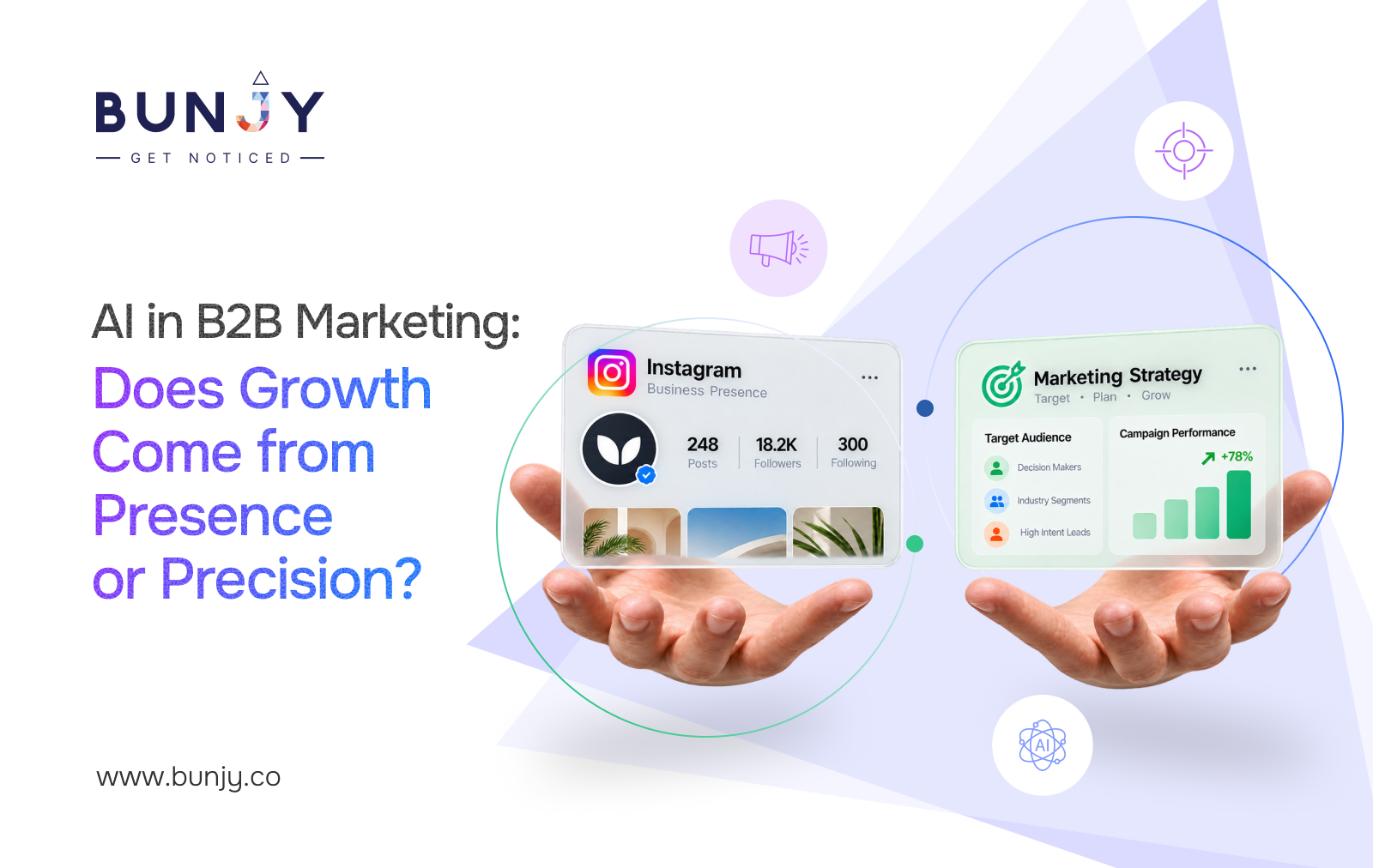
The New B2B Marketing Question
For years, B2B marketers have debated where to invest their resources.Should businesses focus on building a strong market presence through consistent visibility and thought leadership? Or should they prioritise precision targeting, ensuring every campaign reaches the right audience at exactly the right moment? According to us at Bunjy, the rise of AI has amplified this debate.
With advanced targeting capabilities, predictive analytics, intent data, marketing automation, and AI-powered content creation, marketers can now reach highly specific audiences with unprecedented accuracy. At the same time, AI-powered search experiences, recommendation engines, and content discovery platforms are making brand visibility more important than ever.
The reality is that AI is not choosing between presence and precision.It is rewarding organisations that understand how both work together. In this blog, we have tried to explore how presence and precision both matter in an AI driven world.
Why Presence Still Matters in an AI-Driven World
Many B2B companies assume that better targeting means they no longer need broad brand-building efforts.
That assumption can be costly.
Enterprise buyers rarely make decisions after a single interaction. Research consistently shows that B2B buying journeys involve multiple stakeholders, extended evaluation periods, and numerous touchpoints before a purchase decision is made.
Long before a prospect fills out a form or books a demo, they are:
- Reading industry content
- Following thought leaders
- Exploring solutions
- Comparing vendors
- Seeking peer recommendations
- Evaluating credibility
This is where presence matters. A company that consistently appears in search results, industry discussions, LinkedIn feeds, webinars, podcasts, and AI-generated recommendations creates familiarity over time. When buyers eventually enter an active purchasing cycle, they are far more likely to consider brands they already recognise.
AI may help identify opportunities faster, but trust still develops through repeated exposure.
What this means for marketers
Brand visibility should not be treated as a secondary objective. Consistent content, thought leadership, SEO, social media engagement, and industry participation remain critical components of modern B2B growth strategies.
Related Topics:
Ad-Free AI: Moral High Ground or Just a Different Bias?
Top 5 Books on Design Thinking
Digital Marketing for Fashion Brands
10 Instagram Trending Formats You Should Try out!
The Great IT Ad Spend: Are Tech Giants Burning Billions on the Wrong Playbook?
The Rise of Precision Marketing
While presence builds familiarity, precision ensures marketing investments reach the audiences most likely to convert. AI has dramatically improved marketers’ ability to identify buying signals and optimise campaigns.
Today’s marketing teams can leverage AI to:
- Analyse behavioural patterns
- Predict customer intent
- Segment audiences dynamically
- Personalise messaging at scale
- Improve lead scoring accuracy
- Optimise campaign performance in real time
Instead of broadcasting generic messages to broad audiences, organisations can focus resources on prospects demonstrating genuine interest or buying readiness.
This creates significant efficiency gains.
Marketing teams can reduce wasted spend, improve conversion rates, and shorten sales cycles by delivering more relevant experiences.
So, precision is no longer limited to advertising. It should influence content strategy, email campaigns, account-based marketing, website experiences, and sales enablement efforts.
Why Presence Without Precision Falls Short
Many companies invest heavily in content production and brand awareness campaigns but struggle to connect those activities to revenue.
The issue often isn’t visibility. It’s relevance.
Publishing content simply to maintain activity rarely produces meaningful business outcomes. Without clear audience targeting and strategic distribution, even high-quality content can fail to reach decision-makers.
AI is increasingly capable of identifying which content resonates with specific audiences. Marketers who use these insights can focus on creating content that serves both visibility and conversion goals.
Being seen matters but being seen by the right people matters even more.
Why Precision Without Presence Creates Limitations
The opposite challenge is becoming equally common.Some organisations become so focused on targeting and performance metrics that they neglect long-term brand building.
This often works well initially. Highly targeted campaigns may generate leads quickly, particularly when supported by intent data and account-based marketing strategies.
However, over time, these companies frequently encounter growth limitations.
Buyers are less likely to engage with brands they have never encountered before. Acquisition costs rise, campaign efficiency declines, and sales teams face greater resistance during evaluation processes. Precision can create opportunities. Presence often determines whether those opportunities convert.
AI Is Creating a Convergence of Both Strategies
The most successful B2B marketing teams are no longer treating presence and precision as competing priorities. Instead, they are building integrated systems where each strengthens the other.
For example:
- SEO builds long-term visibility and organic discovery.
- LinkedIn content establishes authority and expertise.
- Webinars create engagement and trust.
- AI-powered analytics identify high-intent audiences.
- Marketing automation personalises follow-up journeys.
- CRM systems help align sales and marketing activity.
Each activity contributes to both awareness and conversion. AI simply makes the connections more measurable and actionable. Rather than asking whether presence or precision is more important, organisations should evaluate how effectively their marketing ecosystem combines both.
Another factor reshaping the discussion is the evolution of AI-powered search experiences. Buyers are increasingly discovering information through generative search platforms, AI assistants, and conversational search tools.
These systems often recommend companies based on a combination of brand credibility, consistent online presence, topical expertise and user-generated trust signals.
This means organisations cannot rely solely on paid targeting or outbound efforts. If your brand lacks visibility across digital channels, you risk becoming invisible within emerging AI-driven discovery environments. Companies investing in both search visibility and expertise-driven content are positioning themselves more effectively for the future of digital discovery.The future of B2B marketing is not a choice between presence and precision.AI is rewarding organisations that understand the value of both.
Presence creates recognition, credibility, and trust. Precision ensures marketing efforts reach the audiences most likely to engage and convert.
Businesses that lean too heavily in either direction risk missing opportunities. Those that combine strategic visibility with intelligent targeting are building sustainable growth engines capable of adapting to an increasingly AI-driven marketplace.
The question for modern marketers is no longer whether to prioritise presence or precision.
The real question is: How effectively can your organisation combine both to create lasting competitive advantage?
For more information, explore our digital marketing services in Bangalore.
FAQ
Does AI make brand awareness less important in B2B marketing?
No. AI improves targeting capabilities, but buyers still prefer familiar and trusted brands. Brand awareness remains critical for influencing long-term purchasing decisions.
What is precision marketing?
Precision marketing uses data, analytics, AI, and audience insights to deliver highly relevant messages to specific customer segments based on their behaviours, interests, and intent signals.
Why is brand presence important for B2B companies?
Strong brand presence increases visibility, credibility, and trust. It helps companies remain top-of-mind when buyers begin researching solutions.
How does AI improve B2B marketing performance?
AI helps marketers analyse data, personalise experiences, automate workflows, optimise campaigns, predict buyer behaviour, and improve overall marketing efficiency.
Should B2B companies focus more on SEO or targeted advertising?
Both are important. SEO builds long-term visibility and authority, while targeted advertising helps accelerate lead generation and audience engagement.
What is the biggest B2B marketing trend in 2026?
One of the most significant trends is the convergence of AI-powered targeting with brand-building strategies, creating more connected and measurable customer journeys.
Related Case Studies



Categories: Blog